


Smart Land
Smart Land Competence Centre
Smart Land is the Competence Centre dedicated to a simple idea that is difficult to implement: turning technologies and data into services that work in the field. We do not use “smart” as a label, but as the practical integration of sensing technologies, automation, remote control and data analysis, applied to territories, homes and personal services. The expected result is not a prototype for its own sake: it is a replicable, measurable and governable model, useful to those who must decide and those who must invest.
The Smart Land Competence Centre is driven by Marcello Colosimo, Vice President and Head of the Smart Land Competence Centre. The decision to make responsibility clearly identifiable is not an organisational-chart detail: for Public Administrations, healthcare bodies, industry partners and investors project stability matters as much as technology quality, because it determines continuity, decision-making times and ability to transfer results.

What we mean by Smart Land
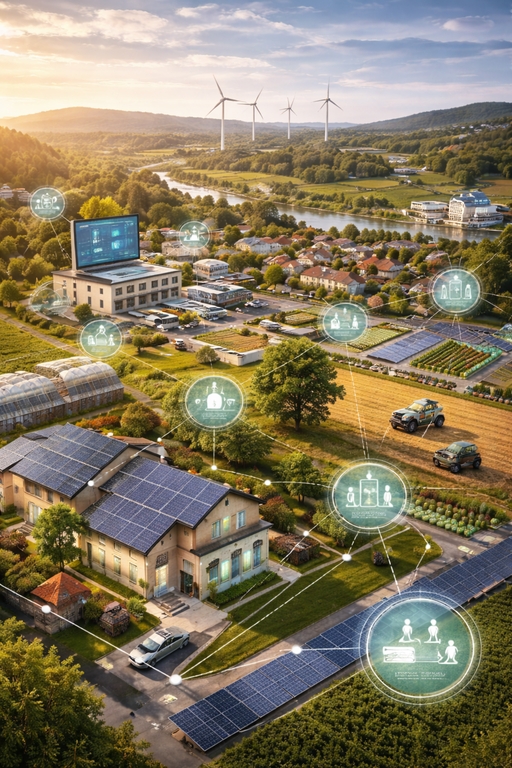
Smart Land is a way of designing territorial and residential settings in which digital infrastructure becomes part of everyday operations: it measures what happens, makes issues and trends visible, enables interventions and improves quality of life and service delivery. In this vision, the territory is not merely physical space and living is not merely construction: they are complex systems in which environment, health, safety, behaviours and service organisation influence each other.
For this reason Smart Land combines three dimensions that often remain separate. The first is thepeople’s real-world experience, especially at moments of vulnerability: community-based care, autonomy, home safety, continuity of care. The second is the operational dimension: processes, responsibility, governance, data quality, economic sustainability and long-term management capacity. The third is the technology, which comes into play only when needed and according to one criterion: it must reduce complexity, do not add it.
Who it is for
For the Public Administration, Smart Land is a tool for designing services and trials that do not stop at “demonstration” but reach replication. It means moving from the idea to a pathway: defining a use case, establish metrics, set up a data governance, clarify the roles between public and private organisations, validate a model in a real-world setting and prepare extension to other districts, facilities or territories.
For investors and companies, Smart Land is an environment for validation and uncertainty reduction. A project becomes interesting when it can be assessed: not only because it “works”, but because there is a credible trajectory linking technology, process and market. In other words, this makes explicit where the value, if in the service, in the data, in theintegration, in thearchitecture or in the replicability, and evidence is built that is useful for partnership, industrialisation and scalability.
The three operational workstreams of the Competence Centre
- Telemedicine and Home Care
The telemedicine becomes genuinely transformative when it is not “one more” app, but an element of the organisational model. In Smart Land the focus is on community-based care and on thehome care, where the challenge is not merely technological: it is the continuity of care, the reduction in avoidable hospitalisation, the chronic-disease management, the relationship with caregiver and the administrative robustness of processes.Here, the work starts from details that are often skipped: which parameters are useful and which generate noise; how thresholds and false alarms are managed; who takes responsibility for and who validates an event; how to build a chain of responsibility that does not place the burden on operators; how clinical information is integrated with the administrative dimension. The value for those governing a territory is having a model that holds up even after the trial ends.
- Assistive home automation and replicable residential units
The home automation, on its own, does not provide care. It becomes a care service when it is designed around theautonomy, to the safety and to the quality of life, with a delicate balance: helping without intruding, signalling without turning everyday life into surveillance, preventing without generating information anxiety.Smart Land works on solutions IoT and home-automation solutions for residential and care environments, with a research line focused on advanced assistive home automation. The objective is to design replicable home-automation-enabled assisted-living units for people with reduced autonomy, integrating behavioural sensors, support automation, solutions for safety and mobility, digital tools for teleassistance and telemedicine and interfaces designed for caregivers and operators. Attention also extends to complex scenarios related to Parkinson’s disease, Alzheimer’s and related dementias, where design quality is measured by how everyday micro-events are managed and by the ability to prevent risks without disrupting daily life.
- Environmental monitoring, sensing and remote control
A “monitored” territory is not automatically a better territory. It becomes one when the data are reliable, when the indicators are useful and when there is a decision chain that links measurement, intervention and verification of effect. Smart Land works on environmental monitoring and intelligent control of spaces and the people who inhabit them, integrating distributed sensing, automation and remote control with systems for data analysis that make data usable for those who manage and plan.Here, the key word is utility: choose what to measure, guarantee quality and continuity, turn data into interpretable indicators, reduce noise and support operational decisions. It is an area that speaks directly to public administration, because it affects sustainability, safety, smart maintenance, management of critical issues and the ability to demonstrate impact with understandable figures.



Our verticals
We design community-based care models in which telemedicine is not “one more platform”, but part of the process. The goal is to make home care and, where needed, integrated home care (ADI) sustainable: continuity of care management, escalation management, reduction of information noise, integration of clinical and administrative dimensions, and metrics that make it possible to measure what genuinely changes in community-based work.
Technology matters here, but the service matters more. We design credible response chains: who responds, within what timeframe, with what context, under which procedures and responsibilities. The goal is to turn teleassistance and emergency telecare into community-based infrastructures: fewer false alarms, more actionable decisions, integration with local networks and, where useful, connection with telemedicine and care environments without creating unmanageable complexity.
The home becomes part of the care system when it is designed to support autonomy and safety. We work on assistive home automation and replicable residential units: behavioural sensors, support automation, restrained signal management, interfaces designed for caregivers and operators, and integration with teleassistance and telemedicine. The objective is to reduce risk and burden without turning everyday life into surveillance.
Measuring is not enough: data must become indicators, and indicators must guide action. We design monitoring and remote-control systems for territories and spaces, integrating distributed sensing, data quality and analytics to make the context governable. The focus is pragmatic: a small number of robust indicators, sensible thresholds, noise reduction, traceability, and a replicable model that remains sustainable over time in maintenance and operations.
A Smart City Lab is effective when it produces evidence, not spectacle. We set up field trials with a clear scope, governance and metrics: define the baseline, test, measure, correct and decide whether to extend. It is a practical way to evolve urban services and spaces by linking innovation to data, sustainability, proximity and quality of life, with transferable results.
We build partnerships that start from real use cases and lead to assessable models: metrics, proof of concept, trials and replication. For the public sector, this means avoiding projects that remain isolated pilots; for companies and investors, it means reducing uncertainty and making it clear where value lies—in the service, the data, the integration or scalability. Context, responsibilities and indicators come before promises.
From use case to replication: how we work
The Smart Land Competence Centre does not start from the solution; it starts from the well-defined problem. A use case rigorous clearly defines the objective, stakeholders, constraints, timelines, operational context and available data. From there, we set metrics and evaluation criteria before choosing technology and components, because technology without metrics produces demos, not models.
The next step is to design architecture and process together: what the system must do, who acts, who decides, what is recorded, what is genuinely necessary, which integrations are mandatory and which are optional. Then comes the phase that distinguishes a “talked-about” project from a real one: proof of concept and field trial, where organisational and technical constraints emerge that no presentation can anticipate. Finally, when the results are interpretable and risks have been reduced, we prepare the replication, meaning the part that genuinely matters to public administrations and investors: take what works into other settings without starting again from scratch.
Evidence and pathway 2025
In the 2025 Smart Land consolidated its operational scope through trials that brought together healthcare, organisation and technology. In the field of telemedicine and integrated home care, a advanced trial accredited by ASL RM5 in Municipality of Sambuci, which worked on clinical and administrative components and on the management structure of the model, with an exploratory and organisational phase completed through transfer of a business unit. In parallel, work on home automation and IoT strengthened applied expertise in residential environments and opened the research line on advanced assistive home automation, focused on replicable residential units and to scenarios involving complex vulnerability. On the territorial and environmental side, Smart Land strengthened its positioning in environmental monitoring and intelligent control, with the aim of turning data into a operational tool and not a collection of measurements.
Collaborate with Technoscience
To start a discussion, an initial contact is sufficient. In your message, indicate whether you represent a public administration, healthcare organisation, company or investor, and describe the use case in a few lines: context, objective, territory, constraints and timelines. If a data baseline or infrastructure already exists, specify what is available and what is missing. A well-defined initial request speeds up feasibility assessment and reduces time lost in inconclusive “exploratory” meetings.